
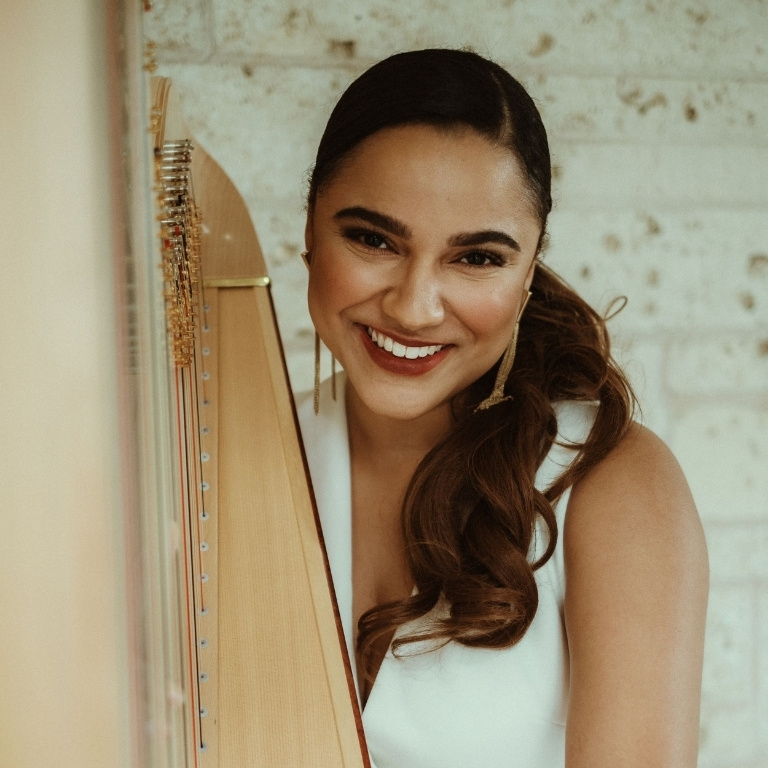
Dr. Mallory McHenry is a dynamic harpist, educator, and arts advocate based in Austin, Texas. She is Lecturer in Harp at the University of Texas at Austin’s Butler School of Music. She also teaches at Austin Community College and runs the Mallory McHenry Harp Studio. Previously, she was Assistant Professor of Music at Southwestern University and Adjunct Professor of Harp and Theory & Composition at Texas Christian University. She also taught in the Round Rock Independent School District Harp Program, where she guided forty developing harpists. Mallory is Co-Artistic Director of the Young Artist’s Harp Seminar (YAHS), a two-week summer intensive at Kenyon College for pre-professional harpists. She is also Vice President of the American Harp Society’s Austin Chapter, where she curates events that build community among harpists.
An active performer, Dr. McHenry has appeared as soloist with the Dallas Symphony Orchestra and has performed with the Dallas Winds, United States Air Force Band of the West, Austin Symphony Orchestra, Waco Symphony Orchestra, Laredo Philharmonic, Valley Symphony Orchestra, and Density512. She has also performed alongside artists including Andrea Bocelli, Take 6, and the Miró Quartet, and has presented recitals and lectures through the American Harp Society Southern Region, Mu Phi Epsilon, and colleges and universities across the country.
Mallory was also a touring member of the Jason Max Ferdinand Singers (JMFS), where she served as Creative Director and Director of Education Advancement. With JMFS, she performed on Saturday Night Live with Coldplay and Jacob Collier, headlined the 2023 National Conference of the American Choral Directors Association, and appeared at the Kennedy Center.
Dr. McHenry was the first harpist named a Young Artist in Residence with American Public Media and National Public Radio’s Performance Today. She later returned to MPR as a founding member of the chamber ensemble e(L)ement for its ClassNotes concert series. Mallory’s research centers equity in classical music, particularly the legacies of Black women composers, which she highlights through original harp transcriptions.